Project
Health Habit Hub
A genuinely useful personal health app on the surface — a structured research engine for studying health habits underneath. Developed at TU Dresden.
The problem
Good intentions rarely become habits.
Most people want to live healthier, yet the tools meant to help them rarely do. Three gaps keep getting in the way.
Gaps I examine across my research publications on digital health and habit formation.
The app becomes the habit
Too many health apps make using the app the habit. Genuine change means the behaviour keeps going on its own, long after the notifications stop.
Not grounded in evidence
Few apps connect recommendations to validated behaviour-change science, so guidance is hard to trust.
Data locked away
The rich behavioural data people generate sits in silos, unstructured and unusable for research.
The idea
An app on the surface, research underneath
The Health Habit Hub looks like a personal health app, and for the people using it, that is exactly what it is. Underneath, it is a research engine: participants donate their habits, and the system turns them into structured, queryable data mapped to behavioural science.
The two sides reinforce each other. The more useful the app is, the more people take part; the more they take part, the richer the knowledge graph and the better the recommendations it can ground.
Fundamentally a research data-collection and analysis tool disguised as a personal health app.
Project documentation
See it in action
A closer look
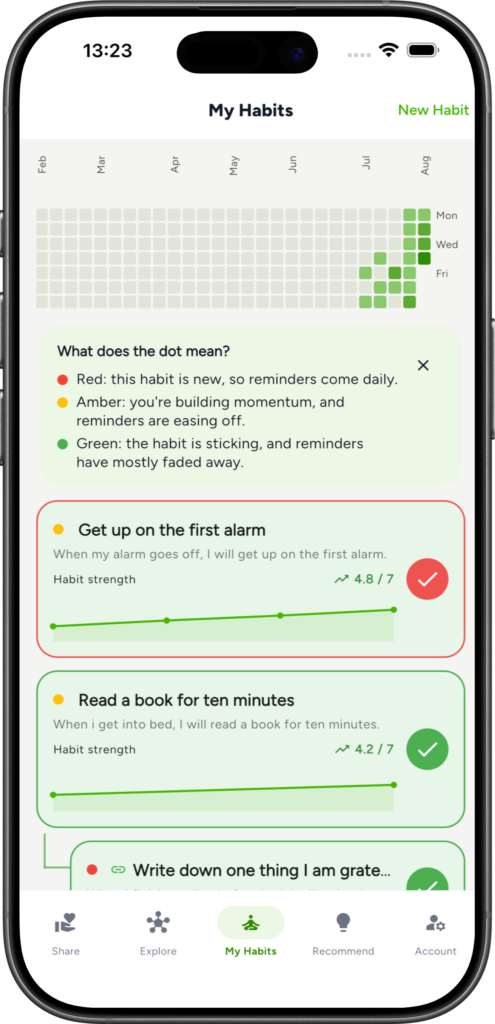
Placeholder screens from the participant app — swap in your real captures anytime.
In the app
Log a habit in seconds
Describe a real habit in your own words and answer a couple of short questions. No streak-shaming, no clutter: a calm, friendly way to capture what you actually do.
In the app
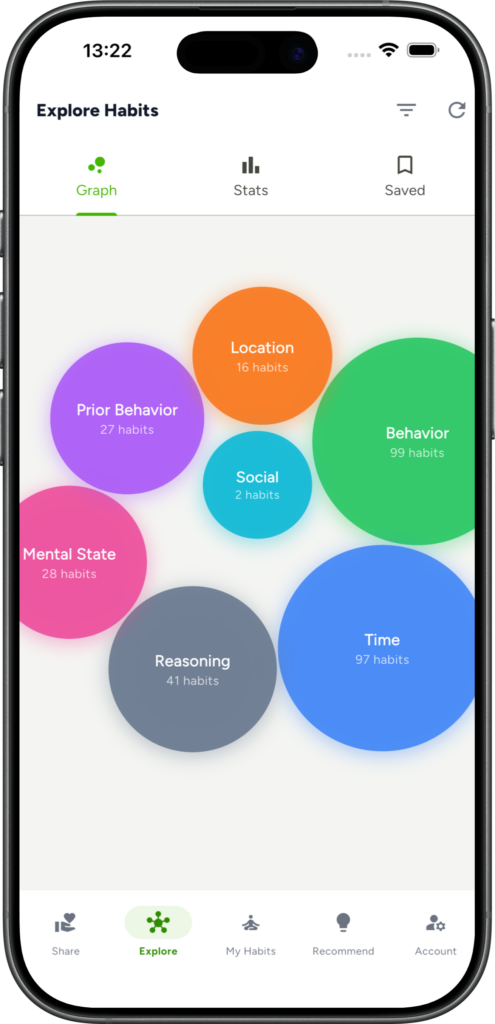
Explore the shared habit graph
Browse the habits other participants have donated in an interactive bubble-graph view. Related behaviours cluster together, so you can pan, zoom and tap through the collective picture, and see where your own habits fit in.
Under the hood
A living knowledge graph
Each donated habit becomes a node in a growing knowledge graph. As contributions accumulate, habits link through shared concepts, self-organizing into clusters that reveal how real habits connect.
What it does
The parts that make it useful for participants and researchers alike.
Log habits in seconds
Describe your real habits and answer short questionnaires in a friendly mobile app.
Mapped to behaviour science
Every habit is matched to the BCIO behaviour-change ontology, so the data means something.
A living knowledge graph
Habits and their relationships live in a Neo4j graph that stays queryable as it grows.
Advice you can trust
Recommendations are drawn from a curated evidence base, grounded rather than invented on the spot.
Made for researchers too
A web portal to run studies, follow participant progress, and curate the knowledge base.
Privacy by design
Participants donate data deliberately, with governance considered from the start.
How it works
1 · Donate
Participants describe their habits and complete questionnaires in a Flutter mobile app.
2 · Structure
Habits are classified in a knowledge graph, enriched against the BCIO ontology.
3 · Recommend
A RAG layer over a curated knowledge base generates personalised, evidence-grounded advice.
How the data flows
The whole system
Inside the recommender
The roadmap
Where it goes next
The platform is built; the research is just beginning.
Now
Validation studies
Testing whether structured, grounded recommendations actually improve habit formation.
Next
Deeper personalisation
Using the graph’s context and history to tailor recommendations further.
Then
Toward a clinical study
Taking the platform into a formal clinical study, with participant data governance strengthened to meet clinical standards.
Later
Open infrastructure
Opening the research platform to other studies and publishing findings.